
Sustainable Compute & AI Infrastructure Symposium
September 17–18, 2026 · Computer Science Laboratories, UMass Amherst
Overview
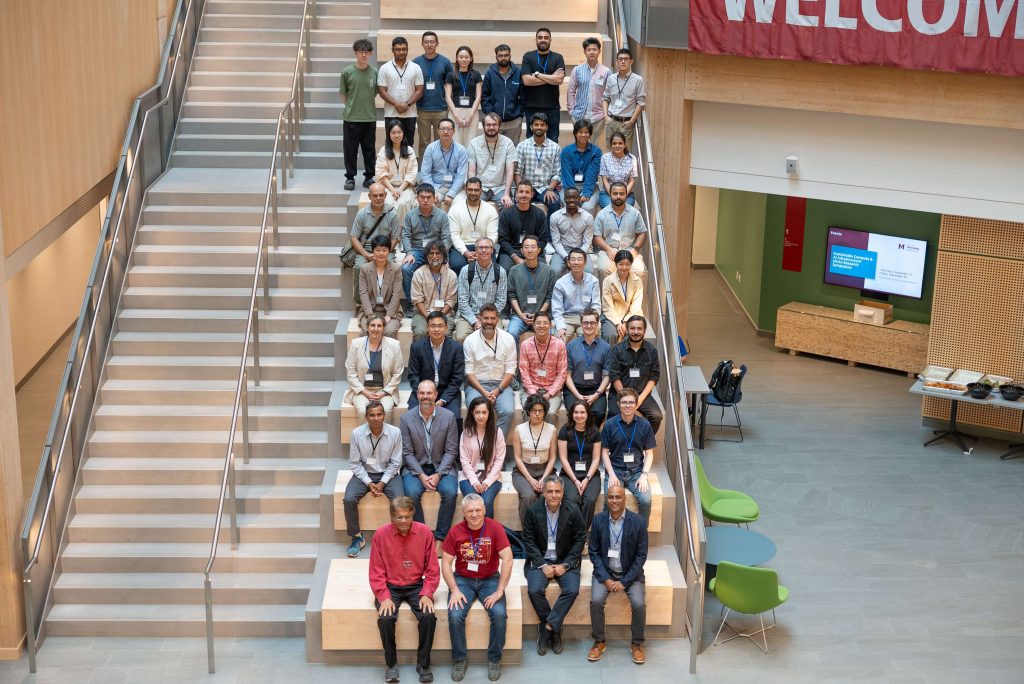
The inaugural SCAI Research Symposium brought together a mix of academic researchers, industry leaders, utilities, government officials, and UMass campus leadership to explore a single, urgent question: how do we build AI infrastructure that respects the resource constraints of the grid, water systems, and communities it depends on? The event grew out of the NSF CoDec Expedition on Computational Decarbonization, a six-university collaboration (UMass Amherst, Carnegie Mellon, MIT, UCLA, University of Chicago, and Wisconsin) led by UMass’s Prashant Shenoy, and was organized by Mohammad Hajiesmaili.
Over two days, the symposium addressed a “shared research agenda” spanning three coupled layers — AI and workloads, computing systems, and energy and infrastructure — reflecting the event’s core thesis: AI infrastructure is a cyber-physical system, and decisions at the model level ripple all the way out to the power grid and surrounding neighborhoods.
Highlights
Opening framing. Expeditions keynotes from Adam Wierman (Carbon Connect) discussed the community externalities of data centers — noise, water withdrawal, backup-generator emissions, electricity prices — and Prashant Shenoy (CoDec) focused on the systems-level efficiency techniques that kept cloud energy growth in check for years, now strained by AI accelerators.
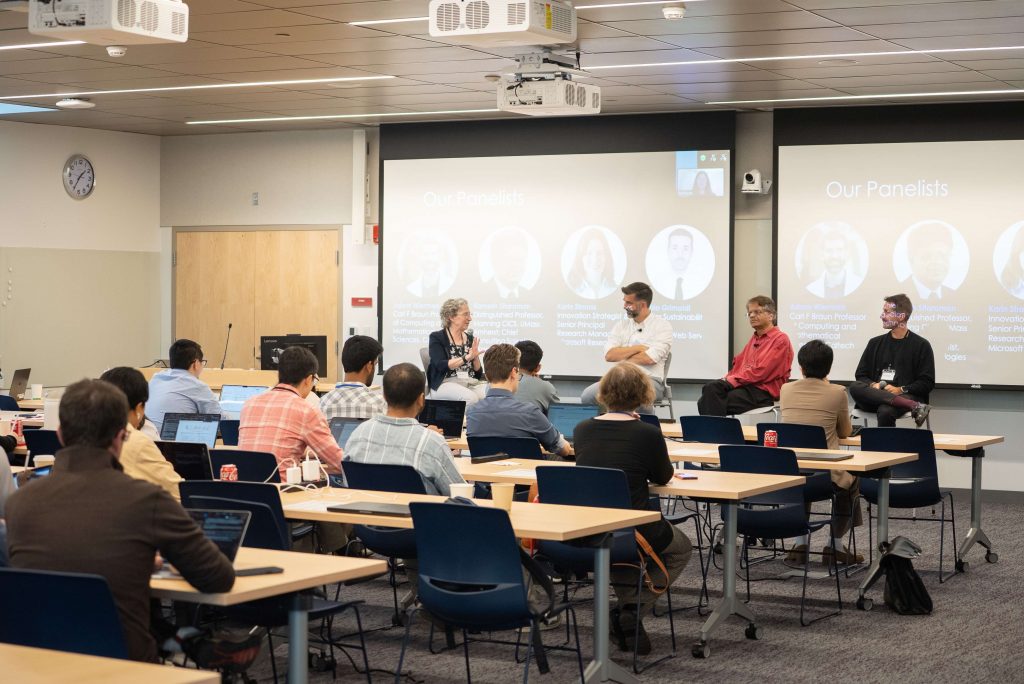
Industry perspectives. Two dedicated industry sessions anchored the program. Karin Strauss (Microsoft Research) and Fabio Grimaldi (AWS) discussed corporate decarbonization strategy — from low-carbon energy supply to lifecycle emissions measurement across chip manufacturing and operations. A second industry session on Day 2 focused specifically on “Flexible Data Centers,” featuring Ayse Coskun (Boston University / Emerald AI), Jeremy Rice (Verrus, ex-Google), and John Goodhue (Massachusetts Green High Performance Computing Center) — all making the case that data centers can become grid assets rather than fixed burdens.
Commonwealth connection. Audrey Chen, Deputy CTO and Director of AI for the Commonwealth of Massachusetts, tied the technical program back to state-level policy — a direct link between the research community and local/regional impact.
Poster session. Sixteen posters covered topics from KV-cache compression and carbon-fair cluster allocation to city-scale decarbonization of residential heating — illustrated a cross-section of the systems-to-society range of the symposium.
Range of focus: industry to community
The successful symposium brought all the stakeholders of a future sustainble AI growth — from hyperscaler engineering (AWS, Microsoft, NVIDIA, Akamai all had a seat at the table) to grid operators and infrastructure providers (MGHPCC, Verrus, Emerald AI) to state government (Massachusetts’s AI office) to fundamental community impact research (water use, electricity prices, noise, environmental justice).